
What is the Preferred Orientation Problem?
Published:
Preferred orientation occurs when most of the particles present the same view in the EM image. This has been a persistent issue for high-resolution structure determination with cryo-EM, especially for asymmetric samples. It is typically caused by the adherence of the sample to the air-water interface or to the substrate of the grid (e.g., carbon film or graphene oxide).
Let’s take the 20S Proteasome as an example.
Figure 1. The side view and top view (A) of the 20S proteasome (EMD-8726). The simulated image with the preferred side view and top view (B). 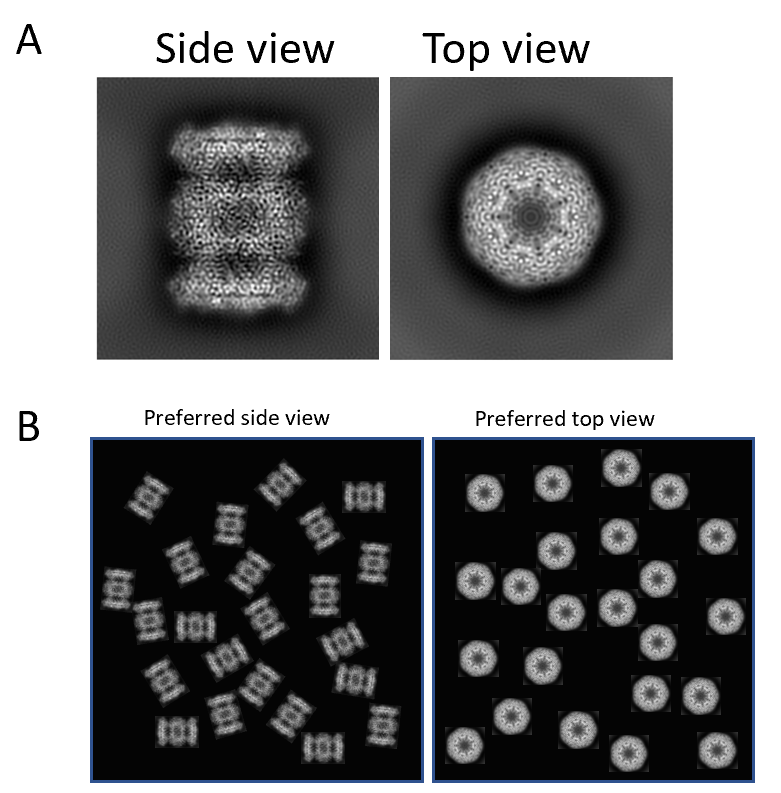
When most of the proteasome particles prefer to lie on the grid, we see many side views as shown in Fig. 1B (left panel). Conversely, when they stand on the grid, only top views are observed (Fig. 1B, right panel).
How Does the Preferred Orientation Affect the Resolution?
To answer this, we first need to understand the central slice theorem:
The Fourier transform of a 2D projection is equal to the central slice of the Fourier transform of the 3D object.
The EM images collected by TEM are 2D projections of the real particle. Cryo-EM image processing reconstructs the 3D Fourier transform of the particle from these 2D projections. Then, by applying an inverse Fourier transform, we obtain the 3D structure.
Figure 2. The central slice theorem. 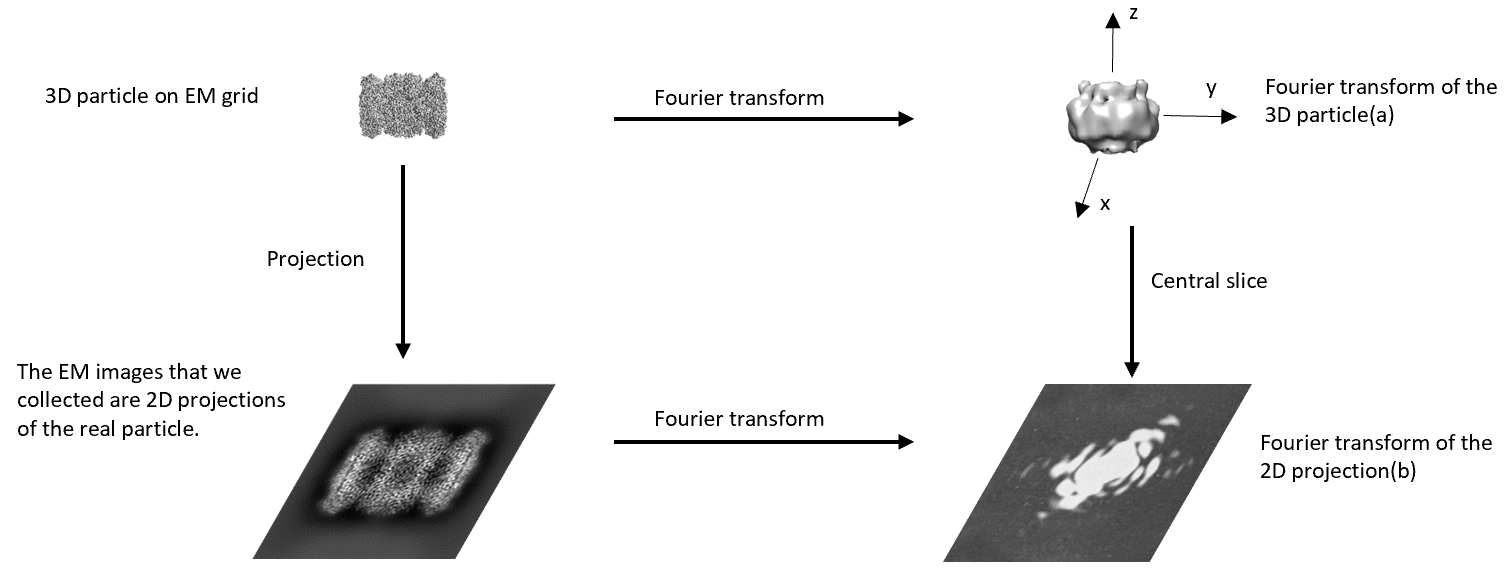
For cylindrical samples like the 20S proteasome:
- If the dataset has preferred side views, it is usually not a big deal.
- If the dataset has preferred top views, it significantly degrades the resolution.
Here’s why:
For side-view preferred datasets, particles still have the freedom to rotate along the y-axis (see Fig. 3A). This results in 2D projections at various rotation angles along the y-axis. After Fourier transforms, these different views populate the 3D Fourier space, which can be inverted to reconstruct the real-space structure.
However, for top-view preferred datasets, z-dimensional information is lost. Particles primarily rotate along the z-axis, so all 2D projections lie on the same XY plane. These projections, when Fourier transformed, still fall on the same plane—failing to reconstruct a full 3D Fourier object. As a result, the structure cannot be resolved.
Figure 3. The reconstruction process of side-view preferred dataset (A) and top-view preferred dataset (B). 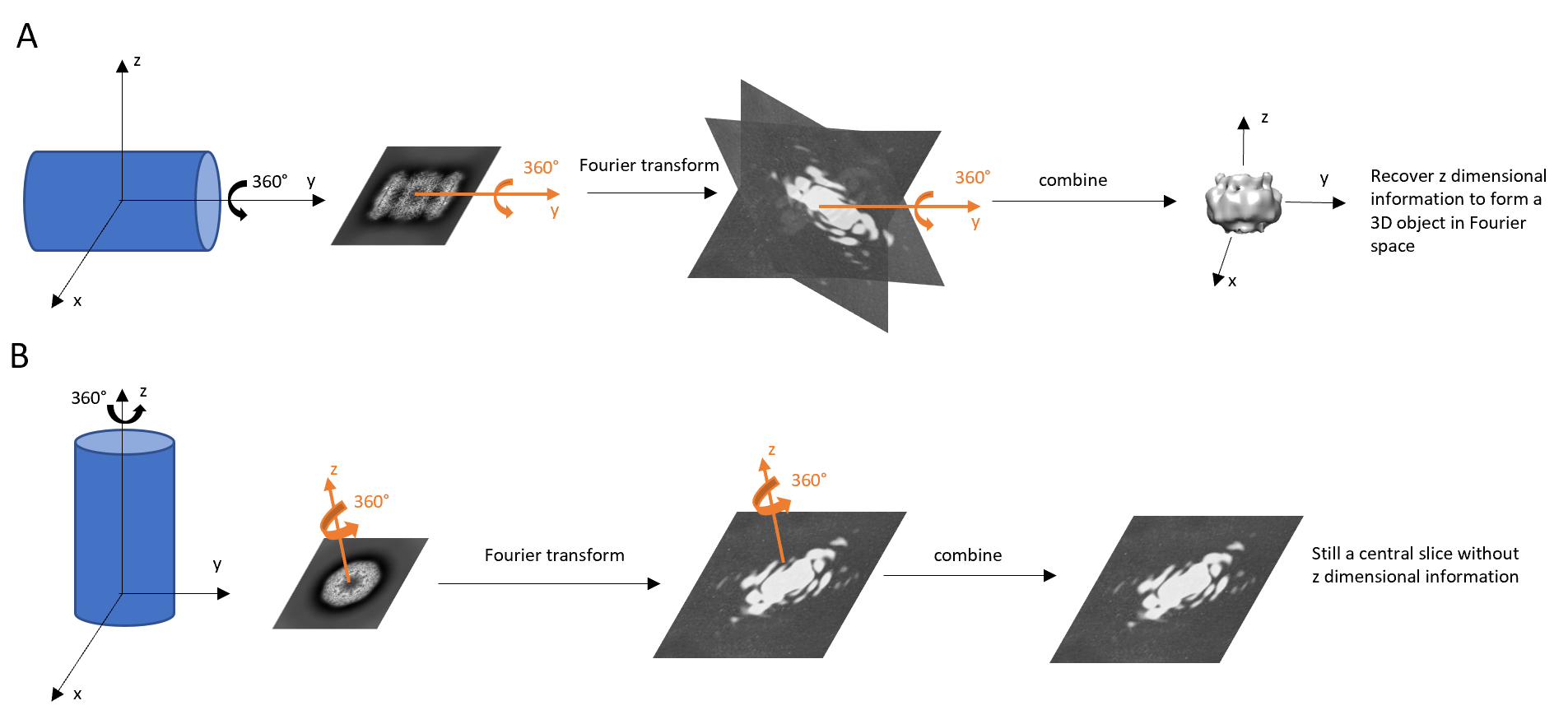
How to Deal with the Preferred Orientation Problem?
Figure 4. The sample orientation on a non-tilted grid (left) vs. a tilted grid (right). 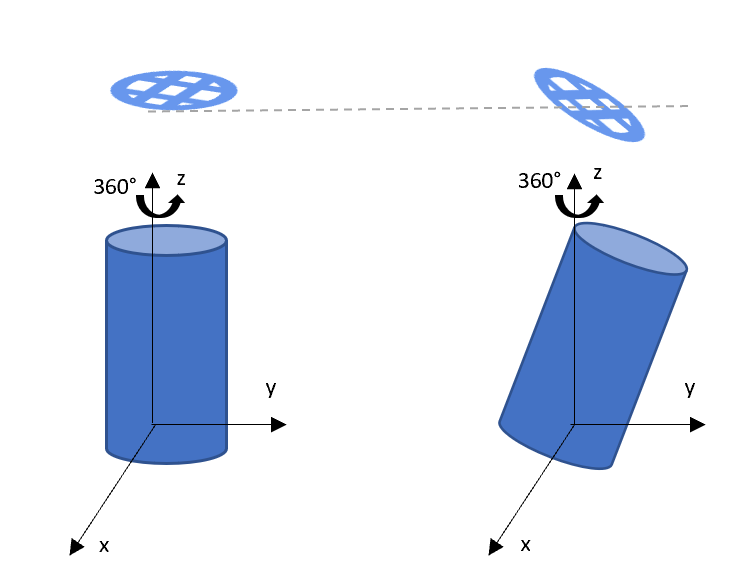
The most common strategy is to tilt the grid during data collection. Tilting the grid is equivalent to changing the orientation of the particles (Fig. 4). This approach helps capture more z-dimensional information in the projection images, improving the resolution and overcoming the limitations of preferred orientation.