
Centrifugation Types and Tips
Published:
There are two main types of centrifugation: differential centrifugation and density gradient centrifugation. Differential pelleting is commonly used to pellet cells, bacteria, and other large particles based on differences in mass, density and shape.
Density gradient centrifugation can be further divided into isopycnic centrifugation and rate-zonal centrifugation.
Isopycnic centrifugation separates particles only based on their buoyant density. It uses a continuous density gradient, which can be either preformed or self-forming (e.g., using CsCl or OptiPrep). In self-forming gradients, the sample is mixed with the gradient material, and the gradient forms during centrifugation. This process typically requires long run times—often overnight—to allow the gradient and particle separation to equilibrate.
Rate-zonal centrifugation separates particles based on their size and sedimentation rate. It often uses a stepwise gradient—a series of discrete layers with increasing density (e.g., 10%, 20%, 30%, 40%). The sample is layered on top of the lightest density layer. This method is widely used for virus purification and typically requires shorter centrifugation times (e.g., one to two hours). However, if spun too long, all particles may eventually pellet, reducing separation resolution.
Sometimes one has to run isopycnic and rate-zonal centrifugation in tandem to enhance purity.
Differential centrifugation or pelleting
- Denser particles are pelleted faster than less dense particles
- Larger particles pellet faster than smaller ones
- Symmetrical particles pellet faster than asymmetrical ones
- Separation is not clean:
- The g-force used to pellet large particles from the top will also pellet small particles from the bottom
Desnsity gradient centrifugation
Isopycnic Centrifugation (Density Gradient Centrifugation, DCC)
- Separates by density
- Can be carried out in all types of rotors
- Requires longer run times
Preformed Gradient
- Sample volume should be smaller than the gradient volume
Self-Forming Gradient
- Sample is homogeneously mixed with a self-forming gradient (e.g., CsCl or OptiPrep)
- Uses solid gradient material or high-concentration gradient solution
- Centrifuge time is longer than with preformed gradients
- Vertical or near-vertical rotors are preferred
- Swinging-bucket rotors, which have longer sedimentation paths, are rarely used for self-forming gradients
Criteria for Successful Isopycnic Separation
- Density of the sample particles must fall within the gradient range
- Any gradient length is acceptable
- Run time must be sufficient for particles to band at their isopycnic point
- Excessive run time has no adverse effect
Rate-Zonal Centrifugation
- Separates by sedimentation rates
- Often used for viral purification or characterization
- Initial sample volume should be small
- If run too long, all particles will pellet at the bottom
Rotor Type
- Swinging bucket rotors
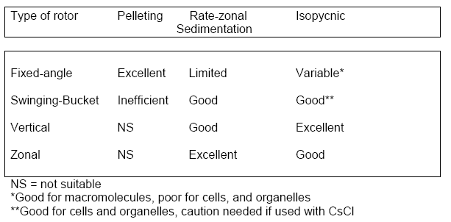
⚠️ Care must be taken to avoid “point loads” caused by spinning CsCl or other dense gradient materials that can precipitate.
Centrifugation Time Calculation
The centrifugation time is given by:
\[t = \frac{k}{s'}\]The k factor is a measure of the pelleting efficiency of the rotor.
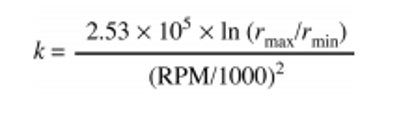
As the k factor decreases, rotor efficiency increases.
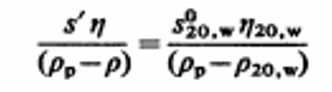 Biochem. J. (1976) 159, 259-265
Where:
- t = Centrifugation time
- k = Rotor k-factor (a measure of the pelleting efficiency of the rotor)
- As the k-factor decreases, rotor efficiency increases
- s’ = Sedimentation coefficient of the particle in a particular gradient at 20°C (in Svedberg units, s)
- ρp = Density of the particle (g/cm³)
- ρ = Density of the gradient (g/cm³)
- ρ₂₀,w = Density of water at 20°C (g/cm³)
- S₂₀,w = Sedimentation coefficient of the particle in water at 20°C (Svedberg units, s)
- 1 Svedberg (S) = 10⁻¹³ seconds
Example
At 4°C in 20% sucrose, the sedimentation coefficient of Tulane virus:
- s’ = 41.87 S
- Rotor: SW55 Ti, 45,000 rpm
- k-factor = 72.4
Calculation: \(t = \frac{k}{s'} = \frac{72.4}{41.87} \approx 1.73\ \text{h} \approx 2\ \text{hours}\) —
Note: The sedimentation coefficient is influenced by the viscosity and density of the sucrose solution. Viscosity is dependent on both concentration and temperature.
Check out the Practical Techniques for Centrifugal Separations for more details.